Stata Bookstore

Quantec holds a wide range of books published by Stata Press. Contuact us for a quote on any of these books.

Seventy-six Stata Tips, 2nd Edition

Seventy-six Stata Tips, 2nd Edition

H. Joseph Newton and Nicholas J. Cox (editors)
Copyright: 2009

Since 2003, the Stata Journal has included Stata Tips on special issues in data analysis with Stata. Now Seventy-six Stata Tips, 2nd Edition compiles these useful guides into a compact tome for ease of reference. In keeping with the Stata spirit, tips are from Stata users and StataCorp employees alike and will serve as guideposts for both new and experienced users. Seventy-six Stata Tips includes the first 33 tips of the series, previously published in the book Thirty-three Stata Tips.

For a more in depth description, please visit the Stata website.

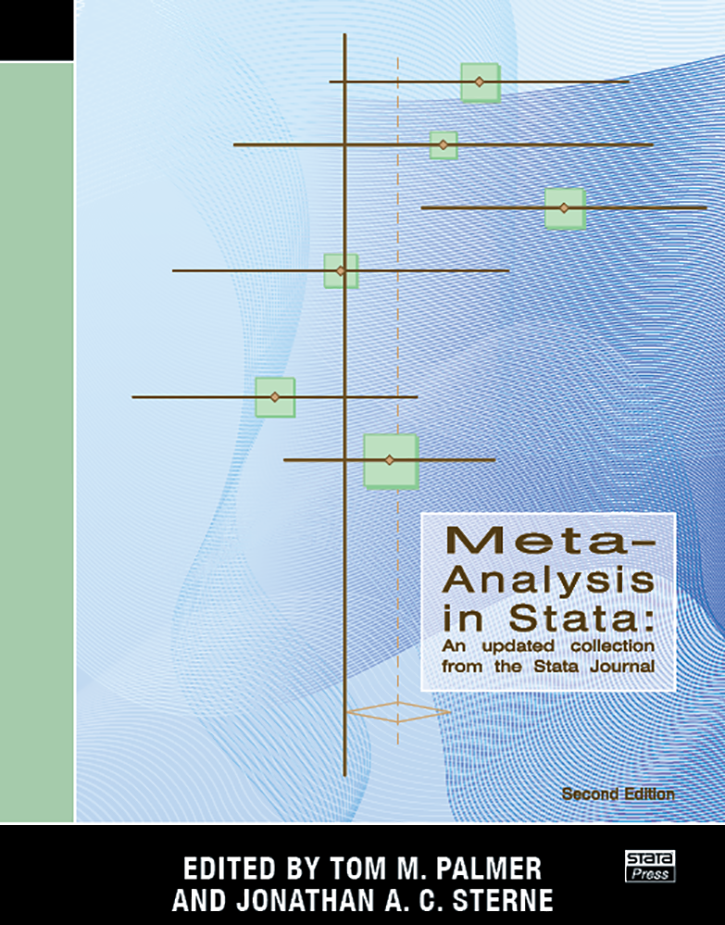
Meta-Analysis in Stata: An Updated Collection from the Stata Journal

Meta-Analysis in Stata: An Updated Collection from the Stata Journal

Jonathan A. C. Sterne (editor)
Copyright: 2009

Stata has some of the best statistical tools available for doing meta-analysis. The unusual thing about those tools is that none of them are part of official Stata, so you will not find them in the Stata documentation. They are all contributed and documented by researchers in the field who also happen to be proficient Stata developers.

For a more in depth description, please visit the Stata website.

Microeconometrics Using Stata

Microeconometrics Using Stata

A. Colin Cameron and Pravin K. Trivedi
Copyright: 2009

Microeconometrics Using Stata, by A. Colin Cameron and Pravin K. Trivedi, is an outstanding introduction to microeconometrics and how to do microeconometric research using Stata. Aimed at students and researchers, this book covers topics left out of microeconometrics textbooks and omitted from basic introductions to Stata. Cameron and Trivedi provide the most complete and up-to-date survey of microeconometric methods available in Stata.

For a more in depth description, please visit the Stata website.

The Workflow of Data Analysis Using Stata

The Workflow of Data Analysis Using Stata

J. Scott Long
Copyright: 2009

The Workflow of Data Analysis Using Stata, by J. Scott Long, is an essential productivity tool for data analysts. Aimed at anyone who analyzes data, this book presents an effective strategy for designing and doing data-analytic projects.

For a more in depth description, please visit the Stata website.

Data Analysis Using Stata, 2nd Edition

Data Analysis Using Stata, 2nd Edition

Ulrich Kohler and Frauke Kreuter
Copyright: 2009

Updated to include changes to Stata over the past several years, Data Analysis Using Stata, Second Edition, comprehensively introduces Stata and will be useful to those who are just learning statistics and Stata, as well as to users of other statistical packages who are making the switch to Stata. Throughout the book, Kohler and Kreuter show examples using data from the German Socioeconomic Panel, a large survey of households containing demographic, income, employment, and other key information. The authors describe the Graph Editor and time-of-day variables, two features added in Stata 10, in this new edition.

For a more in depth description, please visit the Stata website.

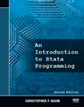
n Introduction to Stata Programming

An Introduction to Stata Programming

Christopher F. Baum
Copyright: 2009

Christopher F. Baum's An Introduction to Stata Programming is worthwhile for anyone wanting to learn about programming in Stata. For the beginner, Baum assumes only that the user is familiar with Stata, and so he builds up accordingly. For the more advanced Stata programmer, the book introduces Stata's Mata programming language and provides optimization tips for day-to-day work. All readers will find better, new ways to approach old tasks.

For a more in depth description, please visit the Stata website.

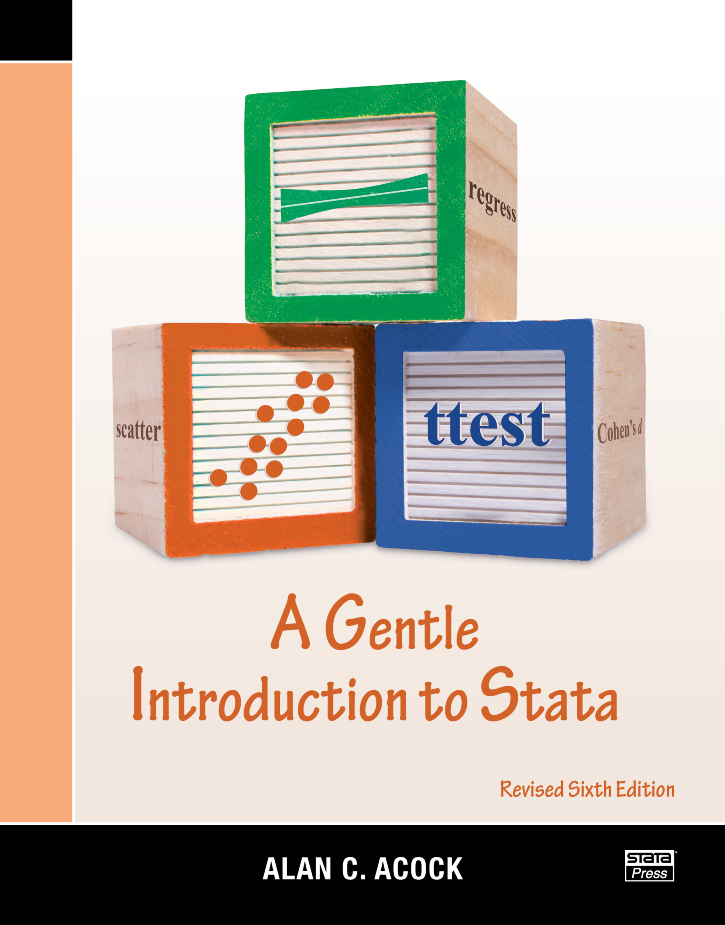
A Gentle Introduction to Stata, 2nd Edition

A Gentle Introduction to Stata, 2nd Edition

Alan C. Acock
Copyright: 2008

Alan Acock's A Gentle Introduction to Stata, Second Edition is aimed at new Stata users who want to become proficient in Stata. After reading this introductory text, new users will not only be able to use Stata well but also learn new aspects of Stata easily.

For a more in depth description, please visit the Stata website.

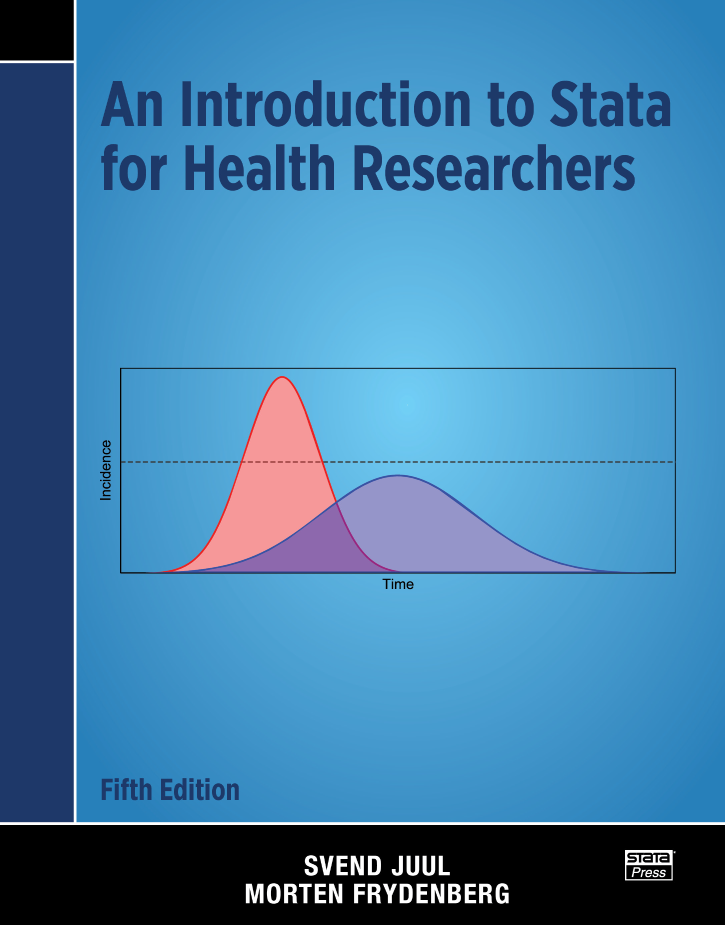
An Introduction to Stata for Health Researchers, 2nd Edition

An Introduction to Stata for Health Researchers, 2nd Edition

Svend Juul
Copyright: 2008

Svend Juul's An Introduction to Stata for Health Researchers, Second Edition is distinguished in its careful attention to detail. The reader will learn not only how to use Stata but also the skills needed to create the reproducible analyses so necessary in the field.

For a more in depth description, please visit the Stata website.

Stata par la pratique : statistiques, graphiques et éléments de programmation

Stata par la pratique : statistiques, graphiques et éléments de programmation

Eric Cahuzac and Christophe Bontemps
Copyright: 2008

Stata par la pratique par Eric Cahuzac et Christophe Bontemps propose une introduction complète à l'usage de Stata en Français. S'appuyant sur des exemples clairs écrits dans un langage simple, cet ouvrage guide l'utilisateur au travers des différentes fonctionnalités de Stata 10. L'ensemble des outils nécessaires à un travail sur données est abordé : exploration des données, statistiques descriptives, modélisation, inférence, tests, graphiques, ainsi que les sorties pour publication. En outre, l'ouvrage inclut également une introduction à la programmation et propose des extraits de code utiles pour résoudre les problèmes fréquemment rencontrés par les utilisateurs. Il contient le matériel essentiel pour transformer le débutant en expert, la clarté de l'ouvrage rendant ce processus particulièrement rapide.

For a more in depth description, please visit the Stata website.

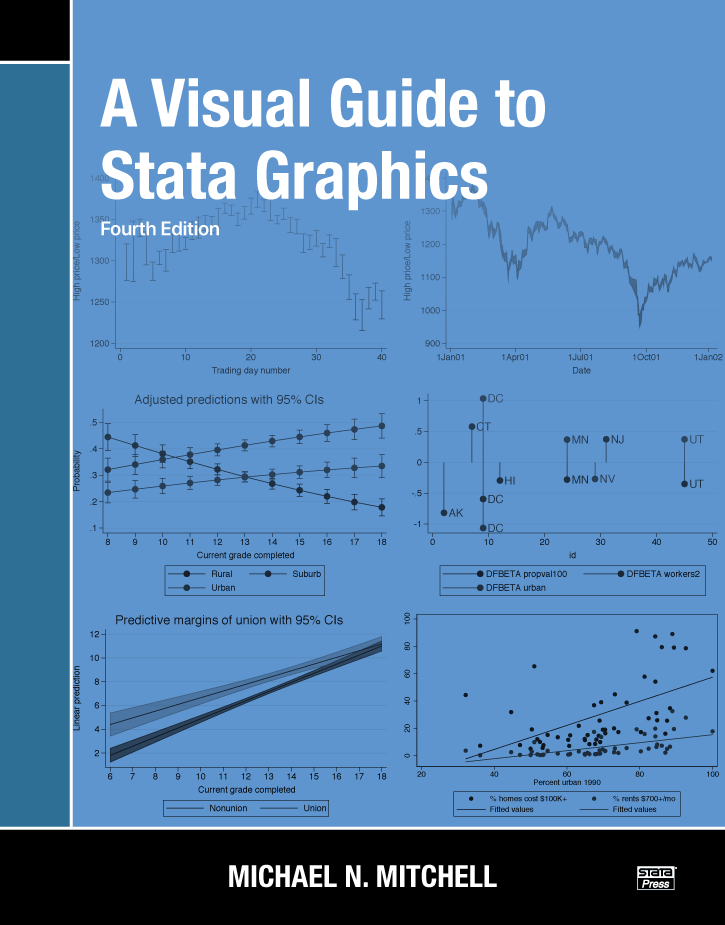
A Visual Guide to Stata Graphics, 2nd Edition

A Visual Guide to Stata Graphics, 2nd Edition

Michael N. Mitchell
Copyright: 2008

Weighing in with 20% more pages than the original, the second edition of A Visual Guide to Stata Graphics is no mere update. Author Michael Mitchell adds coverage of almost every feature added to Stata graphics since the first edition.

For a more in depth description, please visit the Stata website.

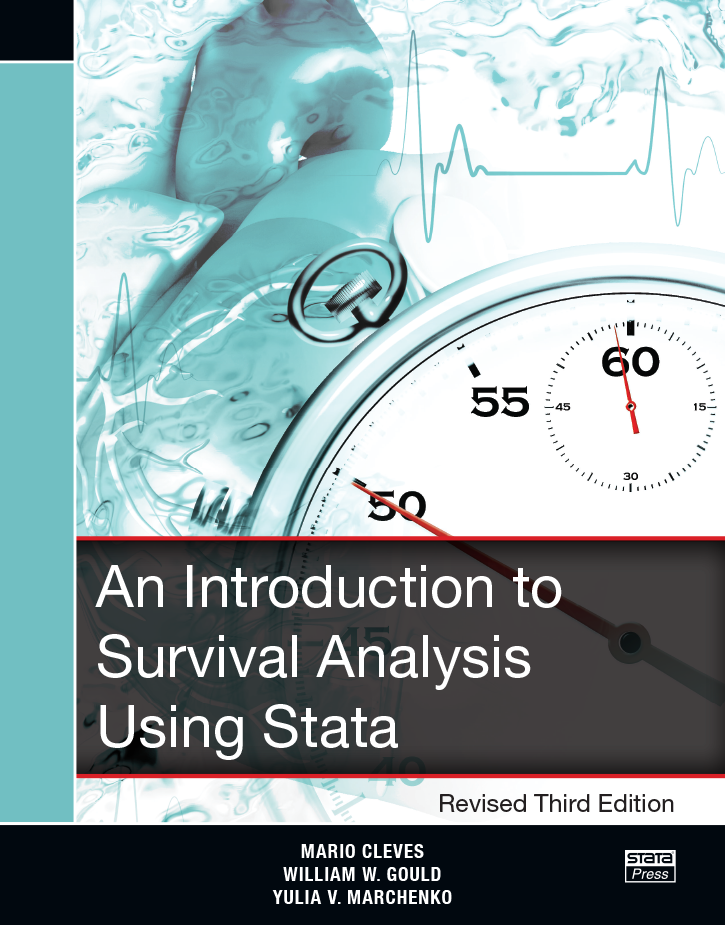
An Introduction to Survival Analysis Using Stata, 2nd Edition

An Introduction to Survival Analysis Using Stata, 2nd Edition

Mario Cleves, William Gould, Roberto G. Gutierrez, and Yulia Marchenko
Copyright: 2008

An Introduction to Survival Analysis Using Stata, Second Edition is the ideal tutorial for professional data analysts who want to learn survival analysis for the first time or who are well versed in survival analysis but not as dexterous in using Stata to analyze survival data. This text also serves as a valuable reference to those who already have experience using Stata's survival analysis routines.

For a more in depth description, please visit the Stata website.

Multilevel and Longitudinal Modeling Using Stata, 2nd Edition

Multilevel and Longitudinal Modeling Using Stata, 2nd Edition

Sophia Rabe-Hesketh and Anders Skrondal
Copyright: 2008

Multilevel and Longitudinal Modeling Using Stata, Second Edition, by Sophia Rabe-Hesketh and Anders Skrondal, looks specifically at Stata's treatment of generalized linear mixed models, also known as multilevel or hierarchical models. These models are "mixed" because they allow fixed and random effects, and they are "generalized" because they are appropriate for continuous Gaussian responses as well as binary, count, and other types of limited dependent variables.

For a more in depth description, please visit the Stata website.

Generalized Linear Models and Extensions, 2nd Edition

Generalized Linear Models and Extensions, 2nd Edition

James W. Hardin, Joseph M. Hilbe
Copyright 2007

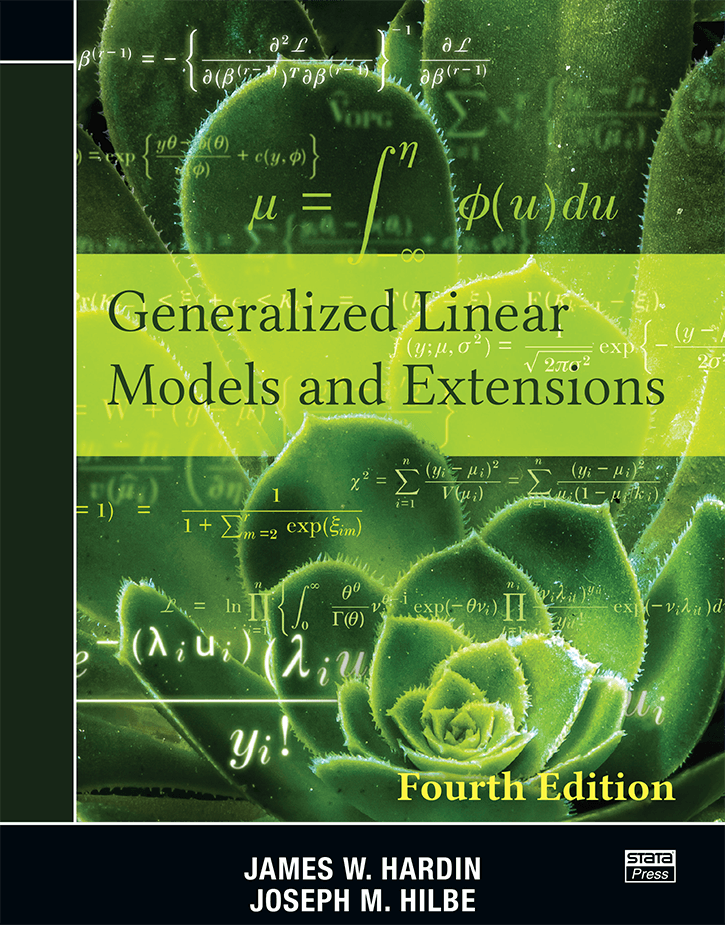
Generalized linear models (GLMs) extend standard linear (Gaussian) regression techniques to models with a non-Gaussian, or even discrete, response. GLM theory is predicated on the exponential family of distributions-a class so rich that it includes the commonly used logit, probit, and Poisson distributions. Although one can fit these models in Stata by using specialized commands (e.g., logit for logit models), fitting them under the GLM paradigm with Stata's glm command offers the advantage of having many models under the same roof. For example, model diagnostics may be calculated and interpreted similarly regardless of the assumed distribution.

For a more in depth description, please visit the Stata website.

An Introduction to Modern Econometrics Using Stata

An Introduction to Modern Econometrics Using Stata

Christopher F. Baum
Copyright: 2006

An Introduction to Modern Econometrics Using Stata, by Christopher F. Baum, successfully bridges the gap between learning econometrics and learning how to use Stata. The book presents a contemporary approach to econometrics, emphasizing the role of method-of-moments estimators, hypothesis testing, and specification analysis while providing practical examples showing how the theory is applied to real datasets by using Stata.

For a more in depth description, please visit the Stata website.

<h3>Maximum Likelihood Estimation with Stata, 3rd Edition

Maximum Likelihood Estimation with Stata, 3rd Edition

William Gould, Jeffrey Pitblado, and William Sribney
Copyright: 2006

Maximum Likelihood Estimation with Stata, 3rd Edition, is written for researchers in all disciplines who need to fit models using maximum likelihood estimation. This edition offers a wealth of material about the ml command, updated to include new features introduced in Stata 9.

For a more in depth description, please visit the Stata website.

Regression Models for Categorical Dependent Variables Using Stata, 2nd Edition

Regression Models for Categorical Dependent Variables Using Stata, 2nd Edition

J. Scott Long and Jeremy Freese
Copyright: 2006

Regression Models for Categorical Dependent Variables Using Stata, Second Edition, by J. Scott Long and Jeremy Freese, shows how to use Stata to fit and interpret regression models for categorical data. Nearly 50% longer than the previous edition, the second edition covers new topics for fitting and interpreting models included in Stata 9, such as multinomial probit models, the stereotype logistic model, and zero-truncated count models. Many of the interpretation techniques have been updated to include interval and point estimates.

For a more in depth description, please visit the Stata website.